
The Chef who phonetically changed his name and introduced Italian food to America!
It was in the fall of the year 1897, in Borgonovo Val Tidone, near Piacenza, Italy, baby Ettore was born. He would become affectionately known as Hector.

His mother, Maria, and father Giuseppe raised their child to have passion for life and a tireless work ethic.
No one in his little village was surprised that eleven year old Hector had become the apprentice chef at La Croce Bianca, the local restaurant. Although his duties were confined to non-cooking odd jobs, such as potato peeling and dealing with the trash. He later learned more restaurant skills as an immigrant in Paris and London.
It was in 1914, at age 16, Hector arrived at Ellis Island aboard La Lorraine, a French ship.
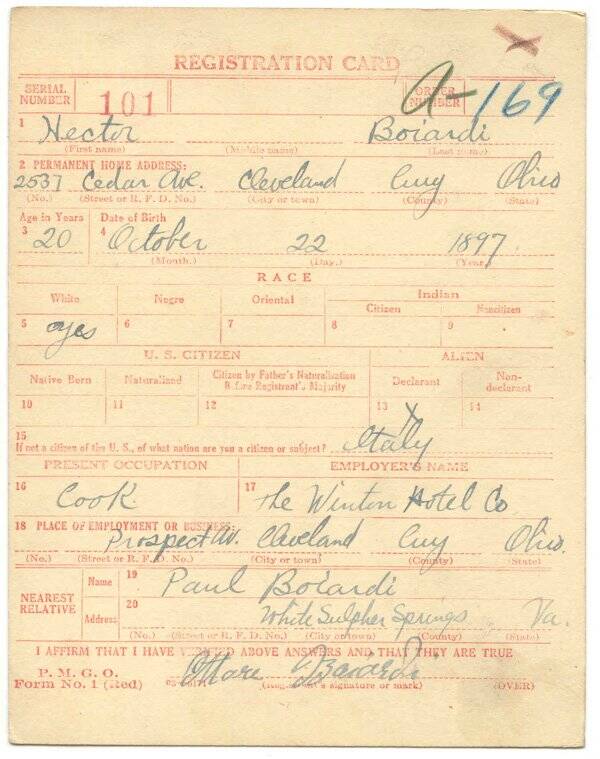
After Hector’s arrival in New York, he worked in a succession of upscale Manhattan restaurants, including those at the Claridge and Ritz-Carlton hotels. He then followed his brother Paolo to the kitchen of the Plaza Hotel in New York City, working his way up to head chef. He supervised the preparation of the homecoming meal served byPresident Wilson at the White House for 2,000 returning WW I soldiers.
Hector moved to Cleveland and worked at first at The Union Club, then became the head chef at the Hotel Winton, where he introduced a menu featuring Italian cuisine, including i spaghetti dinners. His tenure at the hotel lasted until 1924, at which point he departed to establish his own restaurant, Il Giardino d’Italia (The Garden of Italy), at the intersection of East 9th Street and Woodland Avenue. The patrons of Il Giardino d’Italia frequently asked for samples and recipes of his spaghetti sauce, so he began selling it packaged in milk bottles. Italian cuisine was now part of the everyday American lifestyle.
In 1928, Hector and his brothers met Maurice and Eva Weiner, who were patrons of his restaurant and owners of a local self-service grocery store chain. The Weiners helped the Boiardi brothers develop a process for canning the food at scale in Cleveland. They also procured distribution across the United States through their grocery’s wholesale partners.
After spaghetti sauce, their next product was a complete spaghetti meal, including a canister of grated Parmesan cheese, a box of dry spaghetti, and a jar of sauce, held together in a cellophane wrap. Hector’s company was the largest importer of Italian Parmesan cheese, while also buying tons of olive oil. Touting the low cost of spaghetti products as a good choice to serve to the entire family, Boiardi introduced his product to the public in 1928.
During World War II, the U.S. military commissioned the company for the production of army rations, requiring the factory to run 24 hours a day. At its peak, the company employed approximately 5,000 workers and produced 250,000 cans per day.
For Hector’s effort to supply Allied troops during World War II, he was awarded a Gold Star Order of Excellence from the United States War Department.
So this Master Chef Ettore “Hector” Boiardi had to anglicize and phonetically spell out his last name “Boy-Ar-Dee”, ensuring that his name would never be forgotten. CHEF BOY-AR-DEE!
AND NOW YOU KNOW THE ENTIRE STORY!!!
THANK YOU FOR TRAVELING THE BACK ROADS WITH OHB, keeping it real…you can be the judge…